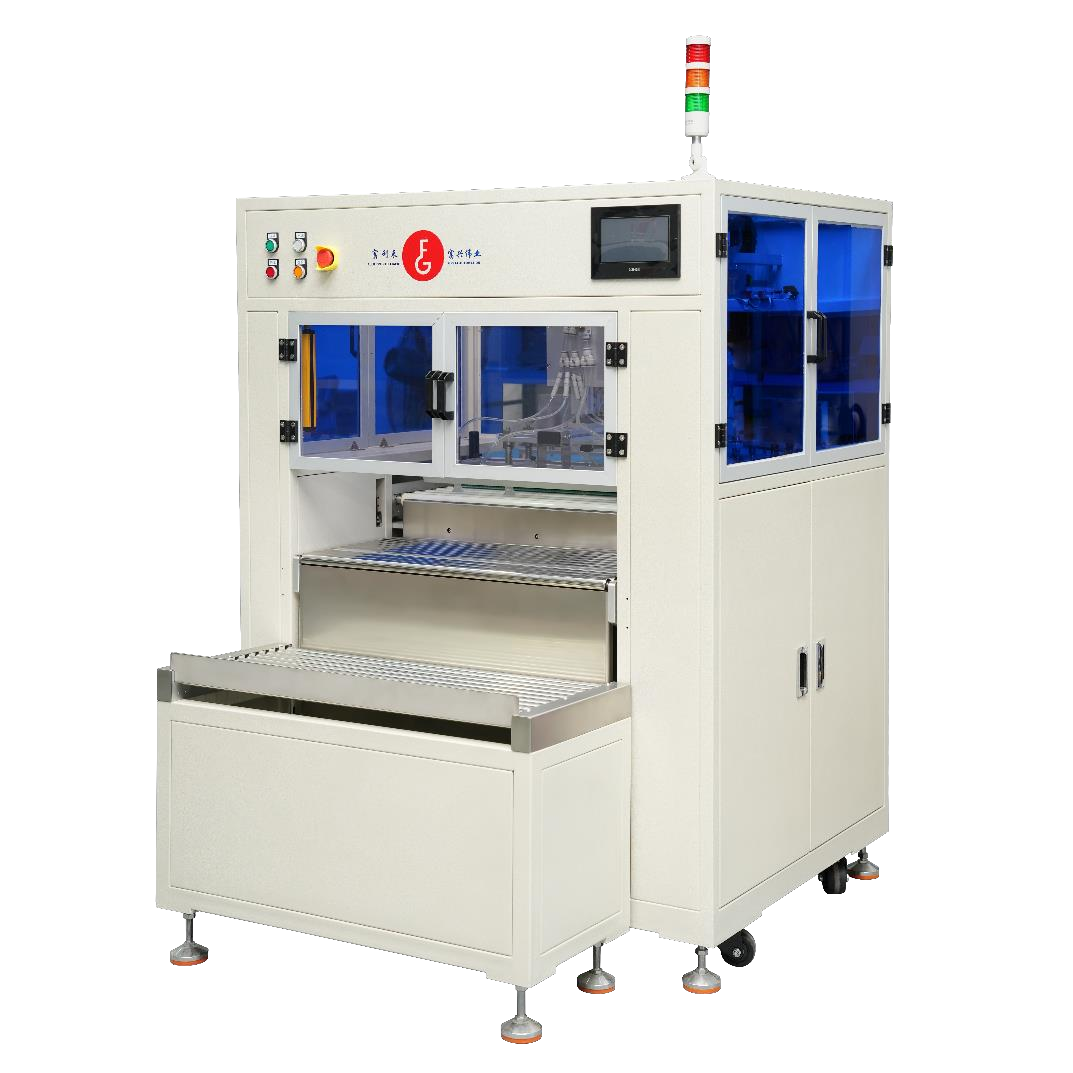
4-Axis vs 6-Axis Robot Loader: One, Two or Three Stations?
Three robot loaders in our range run at the same 7 to 9 panels per minute: the single-station four-axis G-SR401, the two-station six-axis G-SR602, and the three-station six-axis G-SR603. Buyers notice this immediately and ask the obvious question. If the throughput is identical, why does the price differ by roughly the cost of another machine?
The answer is that the panel rate is not the constraint. The constraint is what the robot does while it is not picking, and how long an operator can stay away from it.
What the axis count changes
The four-axis machine rotates the panel around the vertical axis, with the fourth axis able to turn it to any orientation. That is enough for loading and unloading a flat panel, and it keeps the footprint compact: 1.8 m long, 400 kg. The arm approaches the stack from one side only, which is fine when the rack is directly in front of it.
The six-axis machine can approach from any angle within a 730 mm working radius and hold the panel in an orientation that suits the destination rather than the source. That matters when the destination is not a simple conveyor: when the panel has to be placed into a rack at an angle, or when the machine serves two processes set at different heights, or when the downstream machine has a fixture the arm has to reach around.
The payload difference is small, 12 kg against 13 kg, and it is not the reason to choose between them. Neither machine is limited by panel weight in normal PCB work.
What the station count changes
| Item | G-SR401S/F | G-SR602S/F | G-SR603S/F |
|---|---|---|---|
| Axis | 4 | 6 | 6 |
| Stations | 1 | 2 | 3 |
| L-racks supplied | 2 | 4 | 6 |
| Hydraulic trolleys | 1 | 2 | 3 |
| Payload | 12 kg | 13 kg | 13 kg |
| Working radius | not specified | 730 mm | 730 mm |
| Speed | 7-9 PNL/min | 7-9 PNL/min | 7-9 PNL/min |
| Max panel | W730 x L630 mm | W730 x L630 mm | W730 x L630 mm |
| Min panel | W300 x L300 mm | W300 x L300 mm | W300 x L300 mm |
| Thickness | 0.075-3.2 mm | 0.075-3.2 mm | 0.075-3.2 mm |
| Footprint | L1800 x W1300 x H2150 | L1960 x W1900 x H2355 | L2300 x W2300 x H2750 |
| Weight | 400 kg | 800 kg | 800 kg |
| MES and AGV | no | yes | yes |
| Dual panel detection | exit, returns | exit, alarms | exit, alarms |
One operator, one rack, one station: when the rack is empty the robot stops. That wait is short if the operator is standing there, which is exactly the case the single-station machine is designed for. Add a second station and the robot moves to the loaded rack while the operator replaces the empty one. Add a third and the operator can be away for two full changeovers. Panels per minute does not change in any of these configurations; the waiting does.
The rack count deserves attention. Six racks on the three-station machine is not marketing padding: with one rack in use, one being unloaded, one staged at the trolley and spares for a product change, four racks per machine is the realistic minimum for a shift. Buyers who order two racks usually come back for more.
Where each one belongs
Single station, four axes. One process, one line, low mix, and an operator whose other duties keep them within a few metres. It is the least expensive way to remove one person from a repetitive task, and its 1.8 m footprint fits where a two-station machine physically cannot.
Two stations, six axes. One machine between two adjacent processes, or one operator covering two machines on the same line. The 730 mm radius plus MES connectivity makes it the standard choice for a line that is moving toward lights-out but is not there yet.
Three stations, six axes. High mix and short runs, where the product changes several times per shift and the rack exchange is the real downtime. It occupies a 2.3 x 2.3 m footprint, which is the price of never waiting.
The thin-panel caveat
At 0.075 mm the axis count is not the limiting factor; the suction cup is. A four-axis machine with a properly sized octopus cup group and controlled vacuum will handle thin cores all day, and a six-axis machine with the wrong cup will mark them. When you specify, send the panel drawing with its hole and V-cut pattern, because the cup layout has to avoid the open areas and the vacuum has to be uniform across a panel that flexes.
How to settle it in one meeting
Bring three things: your product mix with thickness range, the process before and after, and the number of rack changes per shift. From those we can say whether the third station pays for itself in your factory, and we would rather tell you it does not than sell you a machine that sits idle. Contact kevin@fulilion.com or +86 13823241155, or come and watch a rack change at the Humen plant and time it yourself.