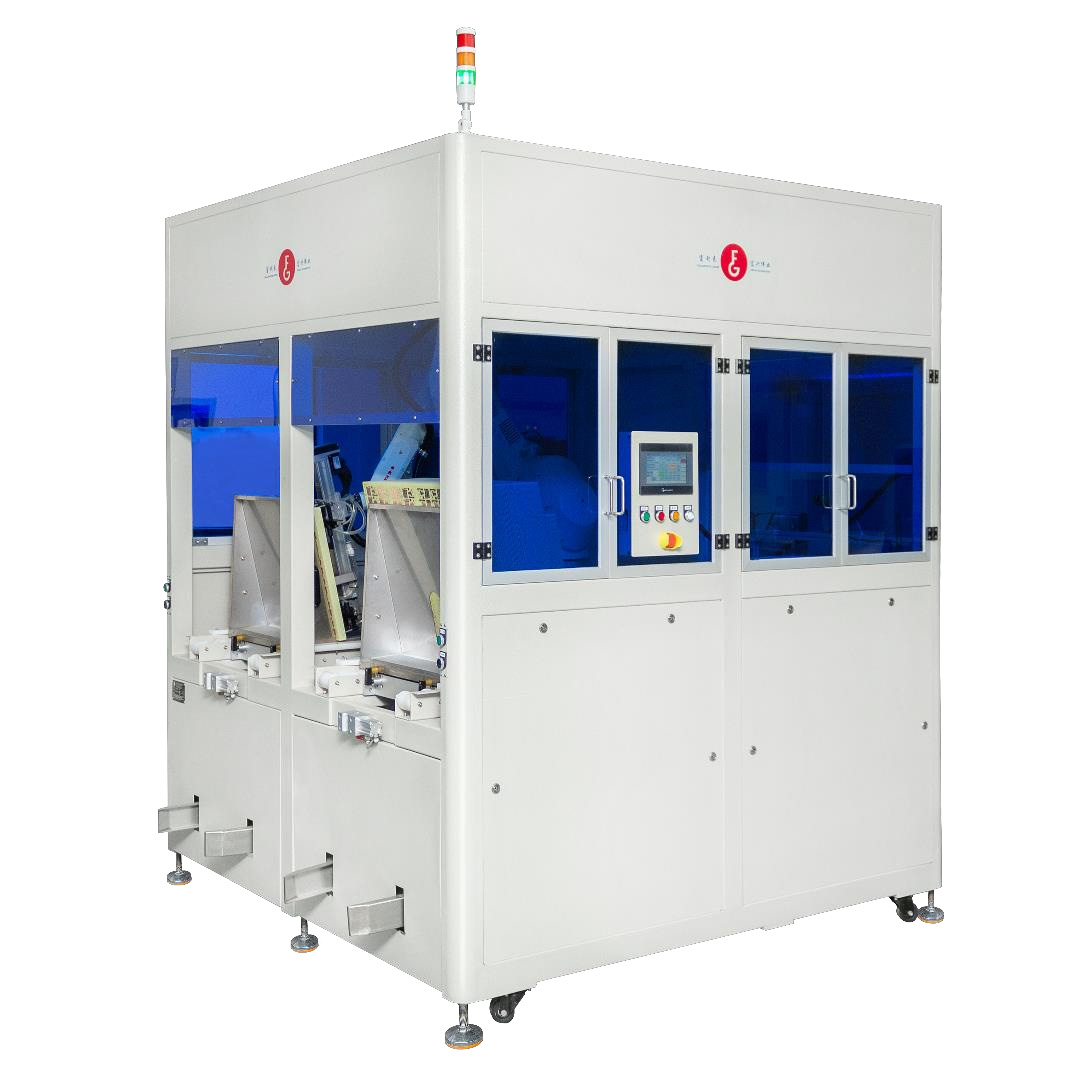
Thin and Small Panels: 0.075 mm Cores and 50 mm Parts
Two panel formats break more automation projects than any other: cores thin enough to flex under vacuum, and small panels that arrive in mixed sizes, with holes and slots everywhere. Both are common in inner layer shops and in OSP or final-finish lines, and both are where a standard loader stops being useful.
Our own datasheets mark the boundary clearly. Most loader and unloader models start at 0.075 mm on the thin side, but the L-rack family starts at 0.5 mm for loading and 0.4 mm for unloading. Panels below 300 x 300 mm fall outside the standard machines entirely and belong to the small-panel range, which accepts down to 50 x 100 mm.
Why thin panels fail on a standard loader
A 0.075 mm core weighs almost nothing and bends easily. Three failure modes repeat on site. The stack is pushed by the feeding mechanism and the top panel slides forward, feeding two at once. The suction cup holds the panel at one point and the free edges curl, so the panel enters the conveyor at an angle. Or the panel is dropped the last few millimetres onto the conveyor and the impact marks the surface that was just cleaned.
The cantilever design exists to avoid the first one. The rack stays outside the machine and the arm reaches in to pick, so nothing pushes the stack. The arm runs on a servo motor and screw module, the roller and clap motors are steppers with adjustable positioning, and dual ultrasonic sensors at the exit detect two panels and return them instead of letting them into the scrubbing or pre-treatment line.
| Item | Cantilever G-IAU901F / 901S | Small-panel loader G-SPAL100N | Small-panel unloader G-SPAU103 | Delta robot F-SPAU1208S / C |
|---|---|---|---|---|
| Panel range | W650 x L550 max, W300 x L300 min | W650 x L390 max, W50 x L100 min | W690 x L380 max, W50 x L100 min | W400 x L400 max, W50 x L100 min |
| Thickness | 0.075-3.2 mm | 0.2-3.2 mm | 0.2-3.2 mm | 0.2-3.2 mm |
| Speed | 8-9 PNL/min | 30 +/-5 picks per minute | 0-8 m/min belt | 0.5-4 m/min, about 60 pcs/min |
| Pick method | arm into rack, servo plus screw | octopus cup, closed-loop stepper arm | 1000 mm movable belt | vision plus dual-station delta |
| Distinguishing feature | dual panel detection returns the panel | check-valve nozzles, dust blow | half or full height storage mode | 6 pcs per row maximum, manual fallback |
| Power | AC220V 1 kW | AC220V 600 W | AC220V 800 W | AC380V 3-phase 5 kW |
| Weight | 500 kg | 350 kg | 250 kg | 1000 kg |
Small panels need a different cup, not a smaller machine
The reason small panels defeat a standard loader is the cup, not the stroke. A panel with holes, slots and V-cut lines cannot be held by a fixed cup array: the nozzles over open areas leak air and vacuum collapses. The small-panel loader uses an octopus cup group with check valves, so each nozzle that lands on a hole or a routed slot closes itself and the remaining nozzles keep their vacuum. That is what allows the machine to pick without being told the panel orientation, position or model.
Two more details matter in that class of work. The arm is driven by a closed-loop stepper rather than an open-loop one, because losing steps on a 50 mm panel is a crash rather than a misfeed. And the machine blows dust off the cup area automatically, since small panels collected after OSP carry flux residue that clogs nozzles within weeks.
Collecting small panels without stacking them
The unloader side is where small panels usually get hurt. Stacking them flat means the operator slides each one, and slides are scratches. G-SPAU103 uses a one-metre moving belt: after a row is complete, the belt indexes back and starts the next line. Two height modes are selectable on the touch screen, about 180 mm for full height and 80 to 120 mm for half height, so the drop distance stays short whatever the panel is.
When the output is high and the panels are delicate, the delta robot unloader takes over. Two stations mean it never stops for a pallet change, a vision system locates each panel and tells the robot where to grab, and it places up to six panels per row at roughly 60 pieces per minute. Pallet or belt output are both available, and a manual mode stays available for panels outside the working range, which is the detail that keeps a line running when an odd job appears.
The specification list for thin and small work
Send four things with your enquiry: the thickness range and the thinnest core, the panel drawing including holes and V-cut lines, whether the process adds paper between panels, and whether the downstream machine accepts row-by-row output or needs single panels. Those four answers decide the cup, the frame and the output type, and none of them can be guessed from a panel size alone.
We keep thin cores and small panels at the Humen factory for exactly this kind of test. Send a sample set and we will run them and send you the video and the readings. kevin@fulilion.com, +86 13823241155.